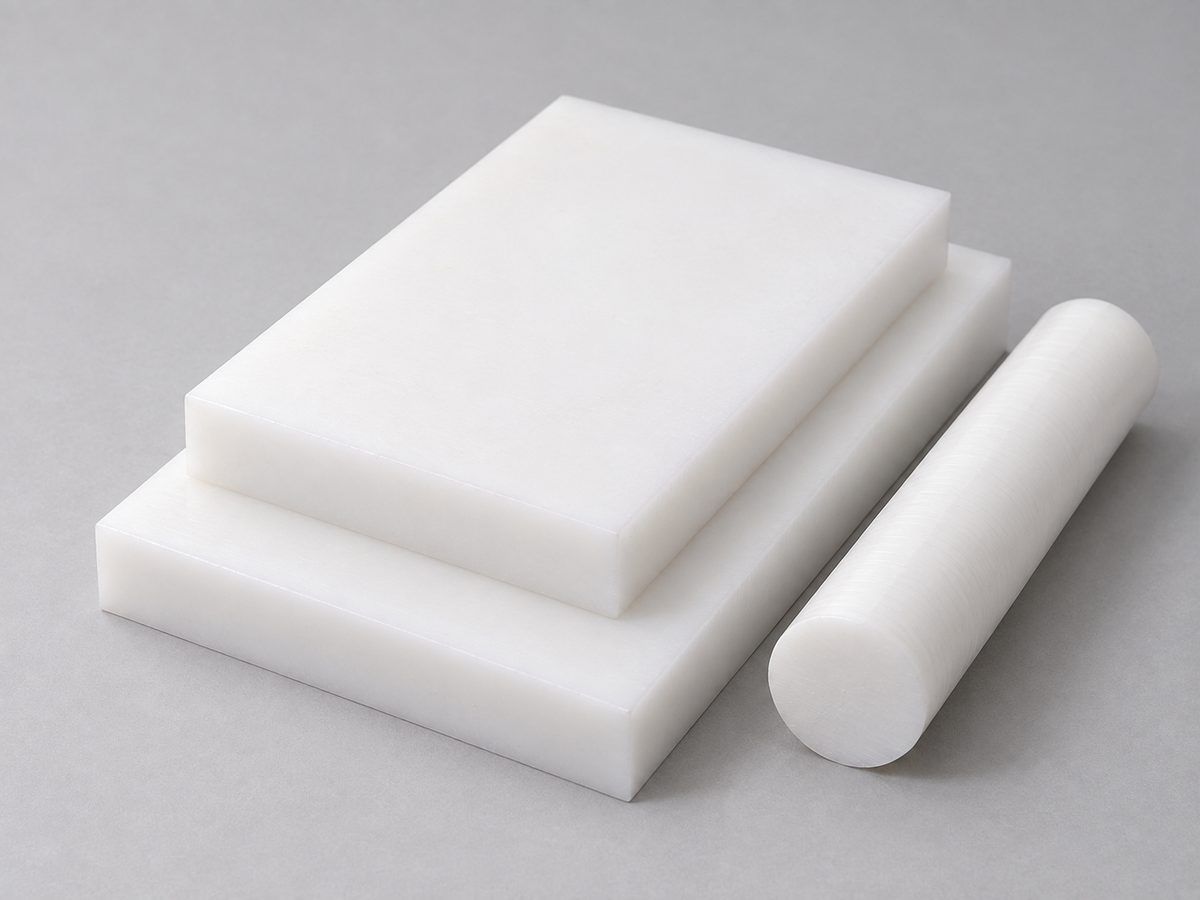
PPPolypropylene
PP (polypropylene) shares many properties with PE (polyethylene) but outperforms it in stress cracking resistance, transparency and tensile strength. It belongs to the group of plastics with the lowest specific gravity, withstands repeated bending (the hinge property) and complies with food hygiene regulations.
- Continuous service temp.
- 65℃
- Specific gravity
- 0.91
- Sheet thickness
- 2~100mm
- Rod diameter
- Φ10~300mm
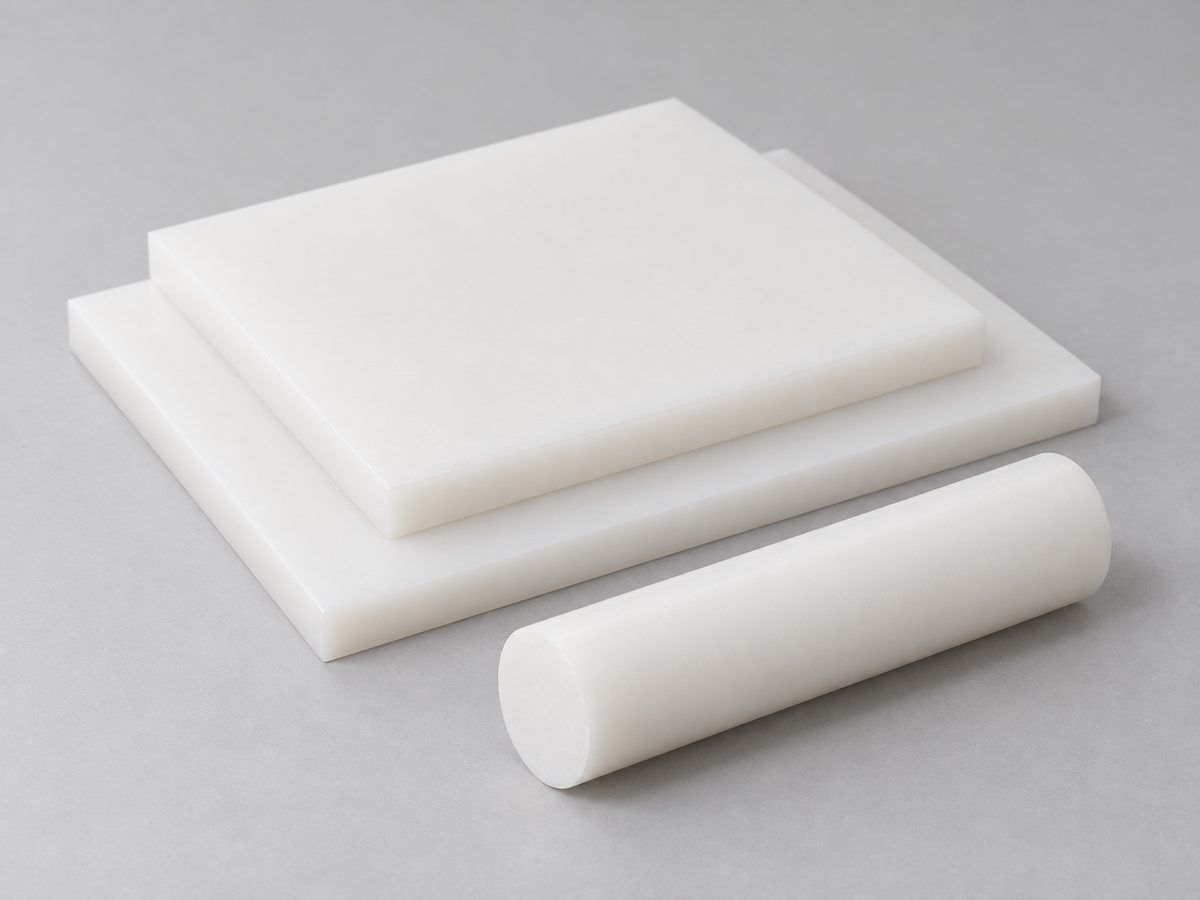
Features
Lightweight
Belongs to the group of plastics with the lowest specific gravity.
Characteristic hinge property
Withstands repeated bending, known as the hinge property.
Food hygiene
Complies with food hygiene regulations.
Stress cracking resistance
Resists stress cracking.
Good surface appearance
Glossy surface that is relatively scratch-resistant.
Properties
| Property | Unit | Test method | PP | HDPE |
|---|---|---|---|---|
| Mechanical properties | ||||
| Tensile yield strength | kg/cm² | ASTM D638 | 330 | 250 |
| Tensile strength at break | kg/cm² | ASTM D638 | 310 | — |
| Elongation at break | % | ASTM D638 | >5100 | 800 |
| Flexural modulus | kg/cm² | ASTM D790 | 17000 | 11000 |
| Hardness | Rockwell | ASTM D785 | R100 | D65 |
| Notched impact strength | kg·cm/cm notch | ASTM D256 | 3.8 | 20 |
| Abrasion loss | mg/1000 cycles | ASTM D1044 | 40 | — |
| Physical properties | ||||
| Specific gravity | — | — | 0.91 | 0.96 |
| Coefficient of linear thermal expansion | ×10−5/℃ | — | 11 | 11 |
| Thermal conductivity | kcal/m·hr·℃ | — | 0.12 | 0.21 |
| Water absorption (24 h immersion) | % | ASTM D570 | <0.01 | <0.01 |
| Specific heat | kcal/kg·℃ | — | 0.46 | 0.55 |
| Continuous service temperature | ℃ | — | 65 | — |
| Flammability | — | ASTM D635 | 1.9~2.1 | 2.5~2.6 |
Typical values; they vary by grade and form. Rows marked “Pending” are still being verified — ask for them with your quote request if you need them.
Sizes
PP sheet
- White
- 2
- 3
- 4
- 5
- 6
- 8
- 10
- 12
- 15
- 20
- 25
- 30
- 35
- 40
- 45
- 50
- 60
- 70
- 80
- 90
- 100
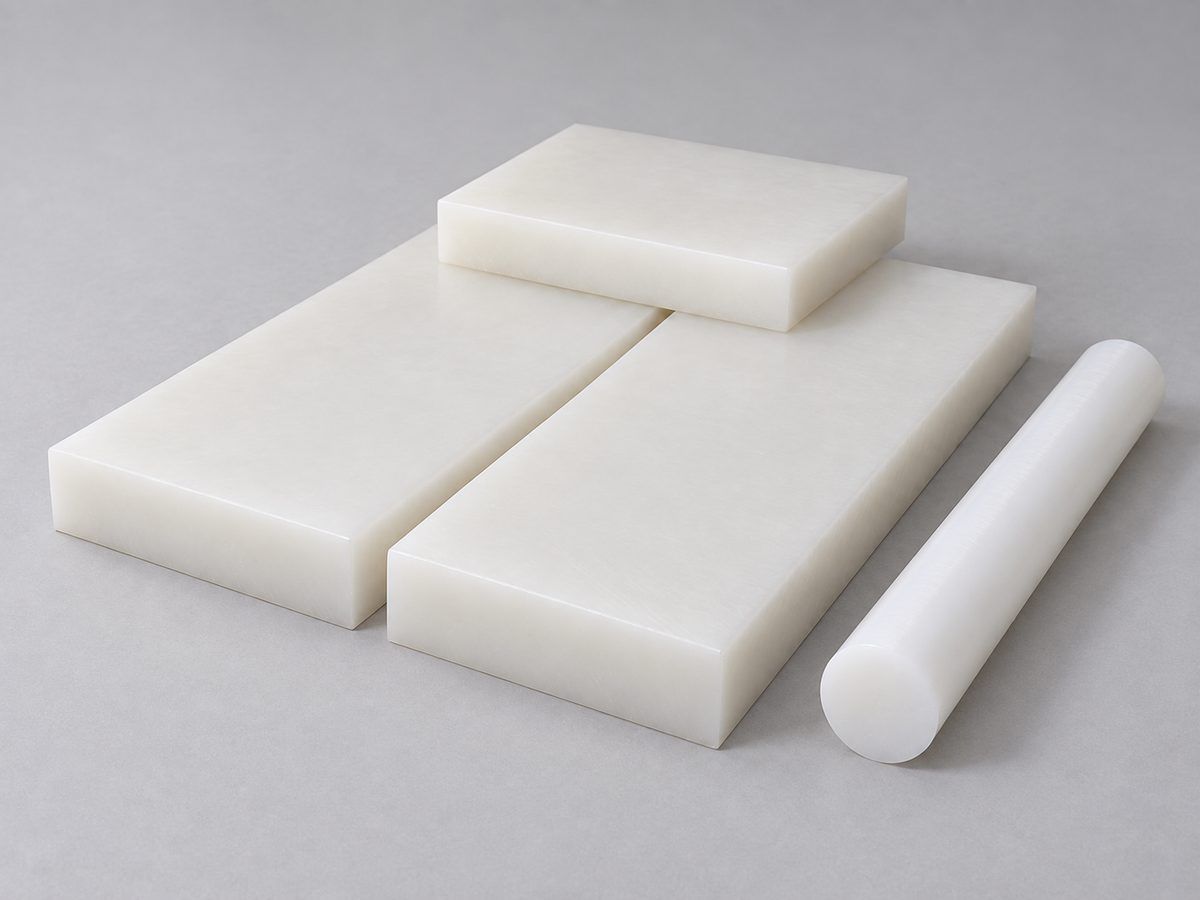
- Sage green
- 5
- 10
- 15
- 20
PP rod
- 10
- 12
- 15
- 20
- 25
- 30
- 35
- 40
- 45
- 50
- 55
- 60
- 65
- 70
- 75
- 80
- 85
- 90
- 100
- 110
- 120
- 130
- 140
- 150
- 160
- 170
- 180
- 190
- 200
- 250
- 300
Applications
- Automotive parts
- Household appliance parts
- Tableware and tabletop goods
- Stationery and office supplies
- Medical containers
- Containers and miscellaneous goods
- Food packaging film
- Textile materials and flat yarn
Technical notes
The defining feature of PP is its resistance to repeated bending, which makes it possible to form hinges (joints). Compared with PE, however, it is weaker against impact at low temperatures and against UV light.
Compare with other materials
Side-by-side comparison guides are in preparation. See each material page for sizes and properties.
Frequently asked questions
What temperature can PP withstand?
Its continuous service temperature is 65℃. Compared with PE, it is weaker against impact at low temperatures.
What sizes of PP sheet and rod are available?
Sheet thicknesses are 2, 3, 4, 5, 6, 8, 10, 12, 15, 20, 25, 30, 35, 40, 45, 50, 60, 70, 80, 90, 100 mm in white and 5, 10, 15, 20 mm in sage green. Rod comes in white, in diameters Φ10, 12, 15, 20, 25, 30, 35, 40, 45, 50, 55, 60, 65, 70, 75, 80, 85, 90, 100, 110, 120, 130, 140, 150, 160, 170, 180, 190, 200, 250, 300 mm.
Can PP be used where it touches food?
PP complies with food hygiene regulations and is used for tableware and food packaging film.
How does PP differ from HDPE?
PP is lighter than HDPE (specific gravity 0.91 vs 0.96) and has higher tensile yield strength (330 vs 250 kg/cm²) and flexural modulus (17000 vs 11000 kg/cm²). HDPE has the higher notched impact strength (20 vs 3.8 kg·cm/cm), and PP is weaker than PE against low-temperature impact and UV light.